
Former Foreign Secretary AP Venkateswaran assesses Chinese Premier Wen Jiabao and the secret of his overwhelming popularity

Congress president Sonia Gandhi on Friday met Chinese Premier Wen Jiabao with both leaders taking note of the steadily growing ties between the two countries.
Probably his only non-political undertaking in his three-day visit to the capital, Wen interacted with nearly 50 students of the school. He spoke for nearly an hour on Rabindranath Tagore, Mandarin, Chinese culture and calligraphy to the students.
The protesters claimed that the visiting leader has no right to talk about border issue.
Wen has postponed an official visit to the Philippines, which was originally scheduled for December 13-14, Foreign Ministry spokesman Qin Gang announced in Beijing on Sunday.
The Indian side reiterated the invitation to Chinese President Hu Jintao to visit India.
External Affairs Minister K Natwar Singh briefed the leaders on the high-profile visits at an hour-long meeting.
The much-awaited hotline between the Prime Minister Dr Manmohan Singh and his Chinese counterpart Wen Jiabao finally became operational on Thursday, thereby setting up a direct communication between the leaders.
Though the issue of stapled visa did not figure in the joint communique, Foreign Secretary Nirupama Rao told reporters after the talks that the Chinese Premier himself raised the issue and suggested that officials from both the countries should have in-depth consultations to resolve the issue.
In his opening remarks during the meeting, Wen said, "We want to have a healthy and steady relationship with India," while Prime Minister Singh congratulated Wen on the 60th anniversary of the establishment of the People's Republic of China.
The dinner was attended by a select few guests like Congress President Sonia Gandhi, Lok Sabha Speaker Meira Kumar, Leader of Opposition in the Lok Sabha Sushma Swaraj and her counterpart in the Rajya Sabha Arun Jaitley, CPI-M leader Sitaram Yechury, BJD leader Jay Panda and National Security Adviser Shivshanker Menon.
Seeking to lower temperatures between India and China in the wake of recent verbal spats, both Indian Prime Minister Dr. Manmohan Singh and Chinese Premier Wen Jiabao did not discuss the territorial dispute over Arunachal Pradesh nor the proposed visit to that state of Tibetan spiritual leader Dalai Lama.
In a bid to remove irritants which have crept in bilateral relations in the last one year, India and China on Thursday reached broad consensus on several issues and pledged firm commitment to resolve outstanding differences, including the boundary issue at the earliest through peaceful negotiations.
About half-a-dozen pacts are likely to be signed during Chinese Premier Wen Jiabao's visit to India during which he will also hold talks with Prime Minister Manmohan Singh on key security and strategic issues and address a public function.
A host of security and strategic issues, including India's concerns over stapled visa to residents of Jammu and Kashmir will be raised by the leadership in New Delhi with Chinese Premier Wen Jiabao when he visits the country from December 15.
Ahead of their talks on key security and strategic issues on Thursday, Prime Minister Dr Manmohan Singh will host a private dinner for Chinese Premier Wen Jiabao after his arrival in New Delhi on Wednesday.

China's economy expanded by 11.1 per cent in the first six months from a year earlier after recording growth of 10.3 per cent for the second quarter, compared with the 11.9 per cent rise in the first quarter.
Prime Minister Manmohan Singh left for Bali and Singapore on Thursday.
China on Tuesday said it looked forward to Prime Minister Manmohan Singh's visit to Beijing to attend the seventh Asia-Europe Meeting next month. "Prime Minister Wen Jiabao has invited Prime Minister Manmohan Singh to come to China next month to attend the 7th Asia-Europe Meeting," said Chinese Foreign Minister Yang Jiechi, who concluded his three-day visit to Delhi.
The CEOs Forum was announced during the visit of Chinese prime minister Wen Jiabao here in December.
India reaction to China protests over the Dalai Lama's visit to Tawang in Arunachal Pradesh is one of studied ambivalence, writes B Raman

During their talks, the two prime ministers agreed on expanding bilateral cooperation in civilian uses of nuclear energy, an issue which has figured during high-level exchanges between the two Asian giants.
Prime Minister Dr Manmohan Singh will be meeting the Republican nominee for US presidency, Senator John McCain, on September 24 in New York. Significantly, Dr Singh will not be meeting the Democratic nominee for the President's post, Senator Barack Obama
The $33 billion Beijing-Shanghai high-speed train will start commercial operations today.
A "political" solution to the boundary issue has to ride on decisive improvement in the political ties between India and China. If in the last six years no such amelioration has occurred, then to expect the boundary resolution track to move faster or even independently of such progress would be wishful thinking.
It is high time India and China did a joint study to protect the river instead of competing to exploit and mutilate it in phases, says environmental activist Gopal Krishna.
Just ahead of Chinese Prime Minister Wen Jiabao's visit to India, several Nepali groups have urged Beijing not to support the monarchy with arms.
Chinese authorities have been highlighting two path-breaking aspects of their assistance for flood relief to Pakistan, which started on August 1, 2010, and continues since then.The first is the value of the assistance, which has already reached US $ 250 million (pledges plus actual amount). This includes a sum of US $ 200 million pledged by Prime Minister Wen Jiabao, in his address to the United Nations General Assembly in New York on September 22.
With China emerging as the second largest economy after overtaking Japan, the ruling Chinese Communist Party made a surprise promise to loosen its firm grip on power structure saying that the gains made out of the economic reform would be lost without political reforms.

Xi Jinping was on Thursday appointed the new general secretary of China's ruling Communist Party of China in a smooth power transition that ushered in a fifth generation of leaders to steer the world's second largest economy over the next decade, ending the 10-year reign of President Hu Jintao.
The importance of political reforms to sustain economic reforms, which was the keynote of the policies advocated by Prime Minister Wen Jiabao, has been given less importance in the deliberations preceding the new Party Congress, says B Raman
Bracing for a once-in-a-decade power change, China's top leadership on Monday appeared relaxed during the 63rd National Day celebrations, as they laid floral wreaths at Hero's Monument in Tiananmen Square in Beijing. The old guard of Communist Party is set to hand over power to new leaders in November after staving off a bid by expelled leader Bo Xilai to wrest control of a key post.
It is learnt that Chinese Air Force planes had refuelled in Pakistan and Iran last month while on their way to Turkey to participate in a joint air exercise with the Turkish Air Force. On the way back, they refueled only in Iran. The air exercise preceded the recent visit of Chinese Prime Minister Wen Jiabao to Turkey.
India and China plan to celebrate the 50th anniversary of Panchsheel.
Chinese President Hu Jintao's exit from the G-8+5 summit to return home to deal with rioting in Xinjiang is considered a setback to the summit at L'Aquila in Italy.
Chinese Premier Wen Jiabao will propose to establish the world's biggest Free Trade Area between China and India during his talks with Prime Minister Manmohan Singh next week.
For net surfers in China, Prime Minister Manmohan Singh is a 'hero'. Dr Singh was pleasantly surprised to learn this from Chinese premier Wen Jiabao at a dinner hosted by the Chinese leader for the Indian Prime Minister earlier this week.
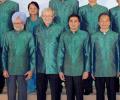
Prime Minister Manmohan Singh skipped his usual attire of pristine white to take part in a photo-op with United States President Barack Obama and the top leaders of Asia.
